The most effective way to study for math and problem-solving courses is to move repeatedly between understanding and production: preview the topic, learn one small concept, attempt a problem without looking at the solution, diagnose exactly where your reasoning failed, revisit it later from memory, and teach the method in your own words. The goal is not to recognize a solution. It is to create one.
I learned this distinction during orientation at Concordia University in a crash course led by Dr. Haleh Raissadat, a Math and Engineering Learning Specialist at the Student Success Centre. Her session gave language and structure to something I had felt before but had not articulated clearly: fluency while reading can be mistaken for mastery.
This article is my attempt to turn the session into a system I can use throughout my BEng in Cybersecurity—and eventually teach to someone else.
Companion resource: Download the complete Learning Strategies for Math and Problem-Solving Courses slide deck (PowerPoint).
The central shift: recognition is not creation
A worked solution can feel obvious when every step is already on the page. That feeling is recognition. An exam asks for something harder: retrieve the relevant knowledge, choose a method, organize the steps, and execute under constraints.
That is why passive review is such an unreliable measure of readiness. The page supplies cues that will not exist when you face a blank sheet. The only convincing evidence of learning is production: can you begin, choose a path, explain why it applies, and reach a defensible result?
The broader research points in the same direction. A meta-analysis of 225 undergraduate STEM studies found that active learning improved examination and concept-inventory performance by 0.47 standard deviations. Average failure rates were 21.8% under active learning and 33.8% under traditional lecturing. Those are course-level results, not a promise about any one technique, but the signal is difficult to ignore: learners benefit when they must do something with knowledge.
For an individual student, the practical translation is simple: reduce the time spent only consuming solutions and increase the time spent generating them.
1. Preview the terrain before class
Previewing is not pre-learning the entire lecture. It is a short reconnaissance pass—roughly 15 to 20 minutes—to create what Dr. Raissadat described as “mental shelves.”
Scan the chapter title, section headings, bold terms, formulas, diagrams, introduction, and conclusion. Ask:
- What is this topic broadly about?
- How is it organized?
- Which symbols or terms are new?
- What prerequisite ideas does it appear to use?
- What should feel familiar when the instructor begins?
The aim is familiarity, not mastery. If the preview becomes a full study session, it has expanded beyond its job.
This also gives you an early warning system. Problem-solving courses are cumulative; a missing prerequisite does not remain isolated. It weakens every layer built on top of it. A quick preview can expose the gap while there is still time to repair it.
Concordia's own guide to learning in problem-solving courses likewise recommends previewing upcoming topics and sample problems, paying attention to new vocabulary and symbols, and reviewing prerequisite material before class.
2. Study in small loops: concept → example → problem
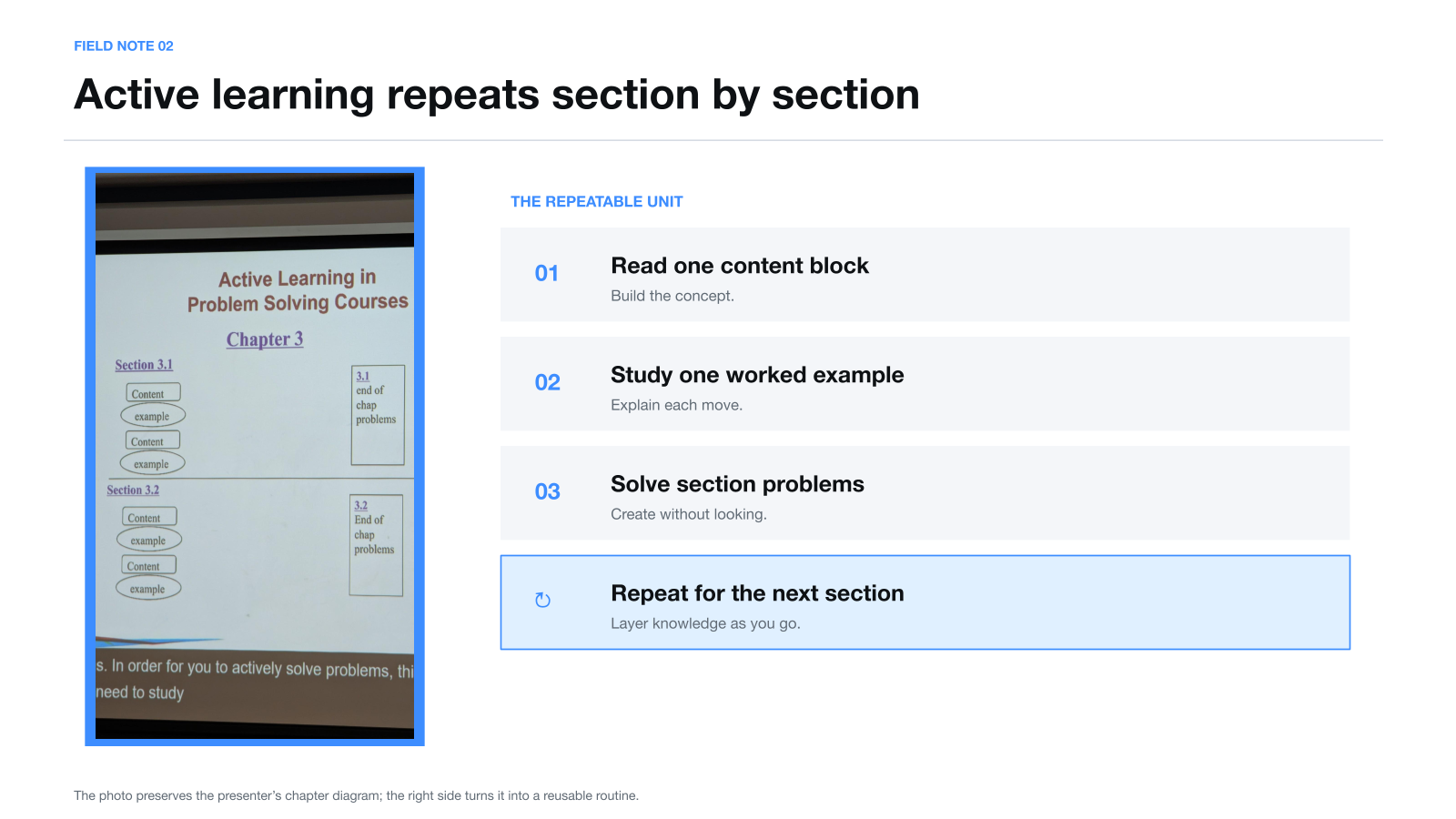
One of the most useful diagrams from the session showed a chapter divided into short, repeated loops. Learn a concept block. Study a worked example. Then solve a related problem before moving to the next section.
Do not read an entire chapter, postpone every exercise, and expect the procedures to remain available at the end. That separates explanation from application by too much time. Instead, bind them together while the relationships are still visible.
For each section:
- Read one manageable concept block.
- Explain the central rule in plain language.
- Study one worked example and account for every step.
- Hide the solution.
- Solve a fresh problem.
- Review the attempt, then continue to the next block.
This is more demanding than continuous reading. That is precisely why it provides better information about what you know.
3. Start from a blank page—and pay attention to where you stop
Getting stuck is not the interruption of learning. It is often the moment learning becomes visible.
Cover the solution and attempt the problem. When progress stops, do not immediately reveal the next line. First, identify the exact obstacle:
- Did I forget a definition or formula?
- Did I fail to recognize the problem type?
- Did I choose the wrong method?
- Could I not translate the situation into a diagram or equation?
- Did I know the plan but make an algebra, sign, unit, or arithmetic error?
“I got it wrong” is too vague to guide the next attempt. A diagnosis should name the failed layer.
I find three categories useful:
- Knowledge: missing definition, notation, prerequisite, or formula.
- Method: wrong pathway, missed pattern, or incomplete plan.
- Execution: algebraic slip, sign error, unit error, or unchecked result.
Once the cause is named, repair that cause and retry with a different problem. Copying the corrected solution can restore familiarity without fixing retrieval.
4. Practise transfer, not just repetition
Repeating the same template with different numbers can make a procedure fast while leaving it fragile. Real mastery appears when the same principle survives a change in representation or context.
After learning from a worked example, vary one important dimension:
- move from an equation to a graph;
- move from a verbal description to a system of equations;
- change which quantity is unknown;
- combine the method with an earlier topic;
- introduce a boundary condition or constraint;
- explain why a tempting alternative method does not apply.
This creates a practice ladder:
- Worked examples teach the purpose and anatomy of a method.
- Section problems combine the ideas just learned.
- End-of-chapter problems require method selection and greater variation.
- Past and mock exams add mixed topics, time pressure, and realistic performance conditions.
Choose problems by what they test, not by how many you can finish.
5. Use retrieval and spacing to make learning durable
Performance immediately after studying is a poor test of durability because the material is still warm. A better question is whether you can reconstruct and apply it after some forgetting has occurred.
A major review of ten common study techniques rated practice testing and distributed practice as high-utility techniques. In a controlled study published in Science, retrieval practice produced greater meaningful learning than elaborative concept mapping, including on questions requiring comprehension and inference.
For a math-based course, retrieval should involve more than recalling a formula. Retrieve the decision process:
- What clues identify this problem type?
- What representation should I construct?
- Which method applies, and why?
- What assumptions or constraints matter?
- How can I check the result?
A simple schedule is enough to begin:
- Today: learn the method and build the first solution path.
- About one week later: solve a fresh problem without notes.
- About two weeks later: use the method in a different representation or application.
If you can still produce and transfer the method at the later checkpoint, you have stronger evidence of mastery than a smooth reread can provide.
6. Build a formula sheet as a decision map
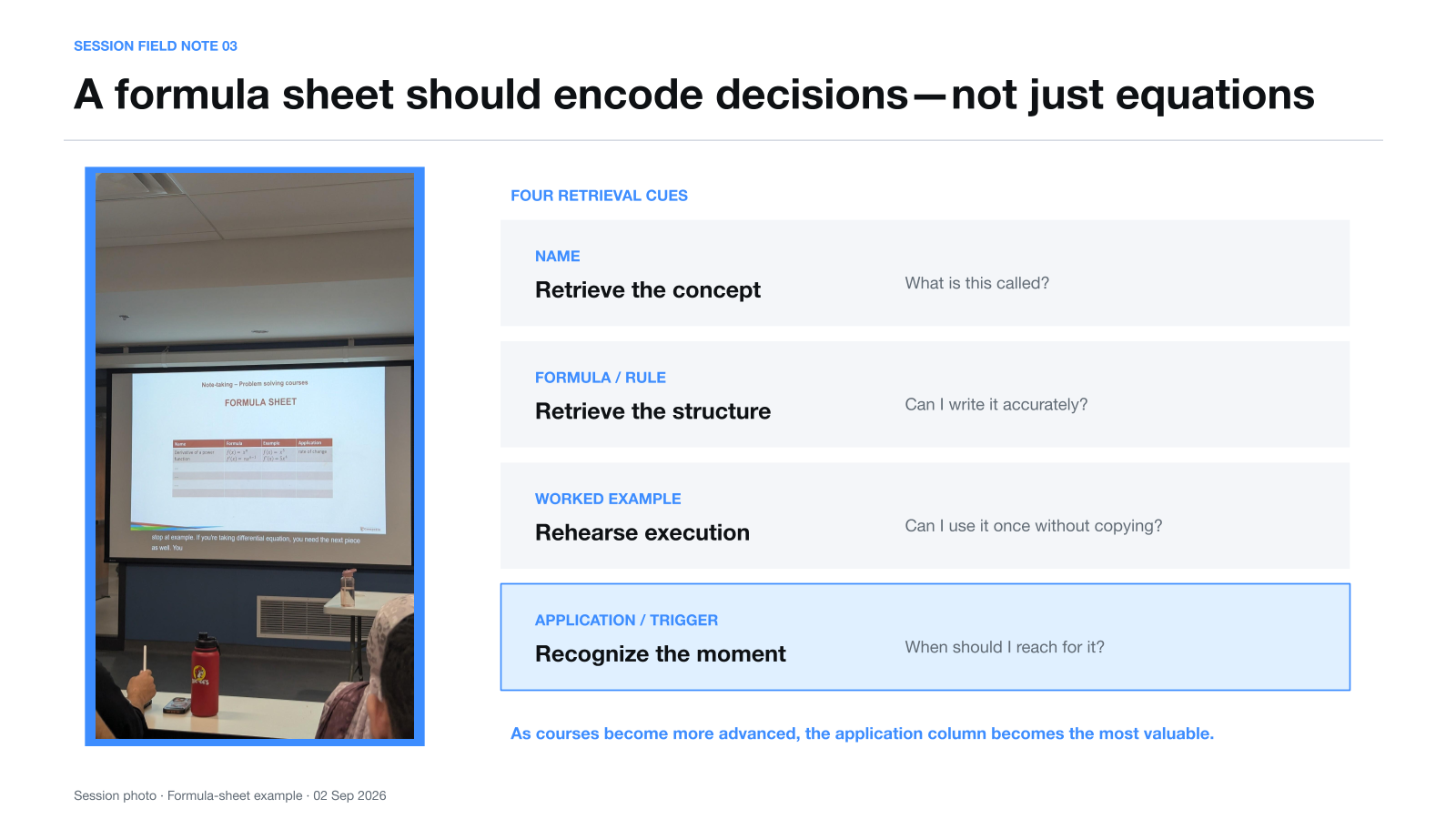
A formula sheet is most valuable while it is being constructed. The act of deciding what belongs on it forces you to retrieve, organize, and connect ideas.
For each weak or uncertain concept, record four things:
- Name: What is the concept called?
- Formula or rule: Can I write it accurately?
- Worked example: Can I execute it once without copying?
- Application or trigger: What clue tells me to use it?
The last column matters more as courses become advanced. Knowing a formula is not the same as knowing when it is relevant.
Do not copy every formula from the course. Prioritize items you are likely to forget, confuse, or misuse. A selective sheet is a diagnostic artifact; a complete transcription is often just another textbook page.
7. Use past exams as blueprints, not reading material
Past exams are valuable because they reveal recurring topics, formats, combinations, and levels of complexity. They become less valuable when used as documents to read.
First, map what the exam demands. Then return to the course material and repair weak topics. Finally, attempt a paper under realistic conditions: closed book where appropriate, timed, mixed-topic, and from a blank page.
The exam is not merely asking, “Have you seen this?” It is asking, “Can you recognize the pattern, retrieve the method, and create the solution quickly enough?”
8. Use AI as a sparring partner, not a substitute performer
Generative AI can support learning, but a polished answer can create the same recognition trap as a worked solution.
Attempt the problem first. Then use AI to increase your thinking:
- critique my approach without completing the solution;
- ask me one diagnostic question at a time;
- generate a new problem that uses the same method in a different context;
- compare two possible methods and make me defend one;
- identify the first unjustified step in my reasoning;
- remove one scaffold at a time as my performance improves.
If the tool does the retrieval, planning, translation, and execution for you, the tool is the one practising.
9. Close the loop by teaching
My favourite principle from the day was also the one I wanted to test immediately: the best way to learn is to teach.
Teaching is not magical by itself. Its value comes from the work it demands—selecting what matters, organizing it coherently, explaining causal links, anticipating confusion, retrieving without the original page, and responding to questions.
A 2024 meta-analysis found that teaching after studying with an expectation to teach produced a learning benefit approaching a medium effect size, Hedges' g = 0.48. Across an additional set of 14 studies, actually teaching after preparation outperformed preparation alone, g = 0.38. The results do not mean any explanation guarantees learning; they suggest that preparing to teach and then genuinely explaining can make study more generative.
My weekly teach-back will use four steps:
- Choose one concept I learned that week.
- Explain the method simply, including when it applies.
- Solve a fresh problem from a blank page.
- Record where I struggled and schedule the retry.
The teaching attempt becomes both a lesson and an assessment.
A weekly operating system for problem-solving courses
The entire approach can be reduced to one repeatable cycle:
Preview → learn → solve → diagnose → transfer → retrieve → teach.
Use it section by section, not only before an exam. A practical week might look like this:
- Before class, preview the structure and prerequisites.
- Within a day of class, redo representative problems without looking.
- During the week, mix section and end-of-chapter problems.
- Log errors by knowledge, method, or execution.
- Revisit a prior topic through retrieval.
- Finish with a short teach-back and a new problem.
This system will not make difficult mathematics effortless. It does something more useful: it makes the difficulty informative.
When to ask for help
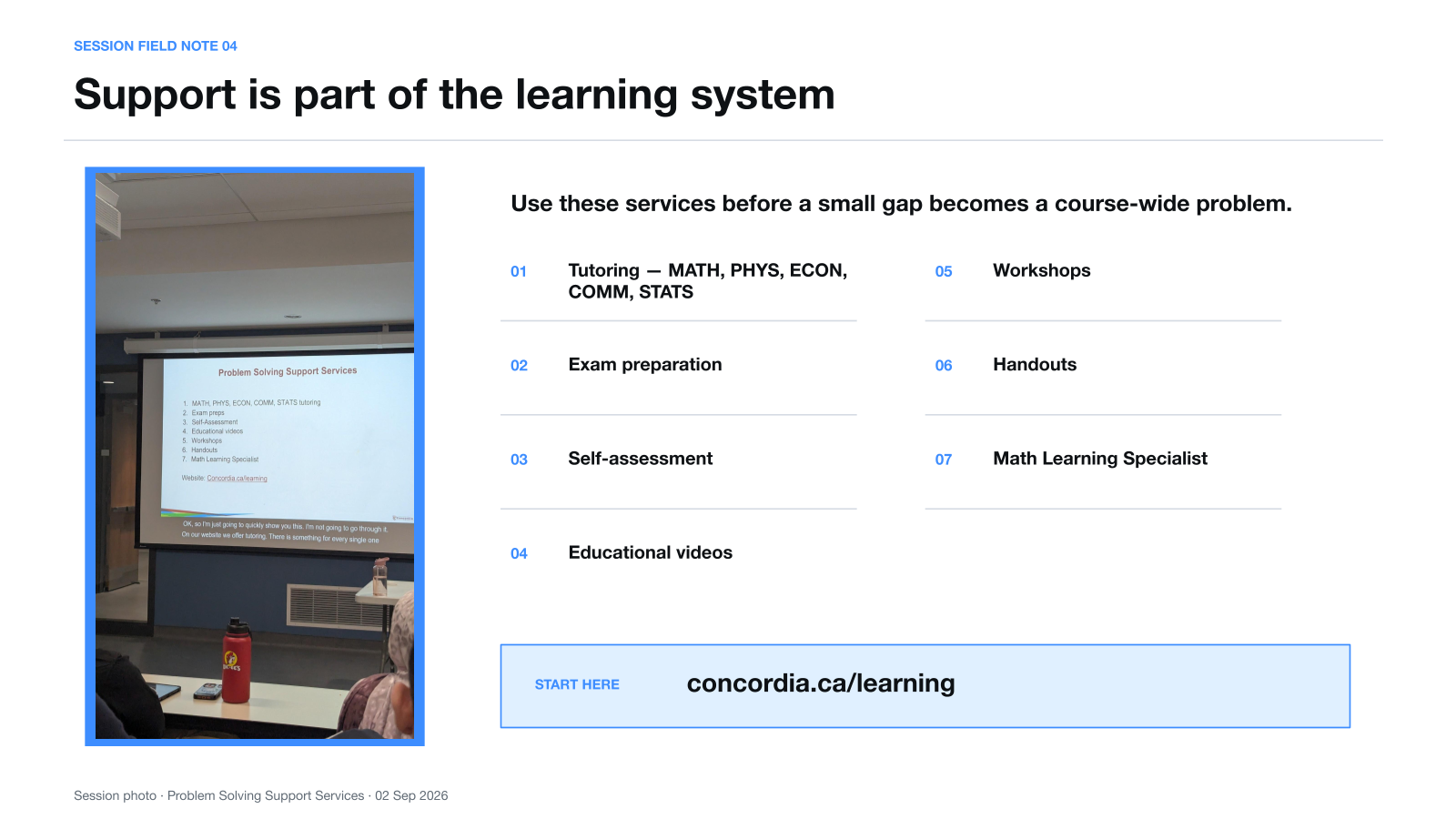
Support should enter the system early, before one gap becomes a course-wide problem. Concordia's Student Success Centre offers self-assessments, tutoring, exam preparation, study groups, workshops, video modules, and learning-specialist appointments for math, engineering, economics, science, statistics, and related courses.
Bring a diagnosis, not just a blank request. “I understand the derivative rule but cannot identify when the chain rule applies” gives a tutor or learning specialist a much better starting point than “I don't get calculus.”
Frequently asked questions
What is active learning in a math course?
Active learning means generating, testing, explaining, and applying knowledge rather than only receiving it. For an individual student, that includes solving from a blank page, explaining why a method applies, checking results, and correcting a diagnosed error.
How long should I preview before class?
About 15 to 20 minutes is enough for most previews. The objective is to see the structure, vocabulary, formulas, and prerequisite links—not to master the lesson in advance.
Should I look at a solution when I am stuck?
First identify the exact point where progress stopped and attempt a smaller next step. If you then consult the solution, reveal only enough to repair the missing idea. Close it and retry the problem—or a similar one—from memory.
What should go on a formula sheet?
Prioritize weak or easily confused material. For each item, include its name, accurate formula or rule, one worked example, and the application cue that tells you when to use it.
Does teaching someone else really improve learning?
Research suggests that preparing to teach and actually teaching can improve learning, particularly when the teaching requires retrieval, organization, explanation, and engagement with questions. A teach-back is most useful when it ends with a new problem solved without notes.
What I am carrying forward
The session changed the question I want to ask while studying. Not “Does this make sense while I am looking at it?” but “Can I reconstruct, explain, and use it when the supports disappear?”
That is a harder standard. It is also a more honest one.
Thank you to Dr. Haleh Raissadat and Concordia's Student Success Centre for the clarity and generosity of the session. The visual notes and framework here are my interpretation of the course, supported by the research and resources linked throughout.